How to Fix a Slice in Golf: Simple Tips for Better Ball Flight

If you have ever watched a golf shot leave the clubface looking perfect, only to see it bend sharply to the right, you already know how frustrating a golf slice can be. You may start aiming farther left, changing your grip between shots, or swinging harder in an attempt to keep the ball in play. Unfortunately, those quick fixes often create another problem.
The good news is that you can learn how to fix a slice in golf without completely rebuilding your swing. In many cases, the biggest improvements come from understanding what your clubface and swing path are doing at impact, then making a few controlled changes.
Whether your slice appears mainly with your driver or affects nearly every club in your bag, this guide will help you identify the likely cause and give you practical drills you can take straight to the driving range.
Table of Contents
What Is a Golf Slice?
A slice is a shot that curves significantly away from your intended target. For a right-handed golfer, that usually means the ball curves from left to right. For a left-handed golfer, the curve goes in the opposite direction.
The important thing is that a slice is more than simply hitting the ball to the right. If your ball starts right of the target and travels relatively straight, you are dealing with a push rather than a slice.
Slice vs. Push vs. Fade
Understanding your ball flight makes it easier to choose the right correction.
| Ball Flight | Starting Direction | Curvature | What It Usually Means |
|---|---|---|---|
| Straight | Toward target | Very little | Relatively neutral delivery |
| Fade | Slightly left/near target | Gentle right curve | Controlled curvature |
| Push | Right | Little curvature | Ball starts right and stays right |
| Slice | Near target or left | Strong right curve | Excessive face-to-path difference |
A controlled fade can be a useful shot. A slice, however, is generally difficult to predict and can cost you both distance and accuracy.
Why Fixing Your Slice Matters
A severe slice can cause several problems:
- You lose valuable distance.
- You miss fairways more often.
- You face longer approach shots.
- You bring hazards and out-of-bounds areas into play.
- You may start making compensations before every shot.
- Your confidence can disappear after only a few holes.
That last point matters. Once you expect the ball to curve dramatically, you may start steering the club instead of making a natural swing.
Why Does a Golf Slice Happen?
Before you try to fix your slice, you need to understand what is actually causing it.
Golf ball flight is influenced by several impact factors, but two of the most important are clubface angle and club path.
For a right-handed golfer, an open clubface relative to the swing path can produce significant rightward curvature. An outside-to-in swing path can make that curvature even more noticeable.
The Clubface Is a Major Factor
Your clubface has a powerful influence on where the ball starts and how it curves.
If the face is open relative to your swing path at impact, the ball can curve to the right. This is why simply changing your swing path without considering the clubface may not completely solve your problem.
Instead of trying to force the clubface closed, focus on developing more consistent face control.
An Outside-to-In Swing Path Can Create a Slice
One of the most common patterns associated with slicing is an outside-to-in path.
In simple terms, your club travels toward the ball from outside the target line and then cuts across it toward the inside.
You may develop this movement because you are:
- Trying to hit the ball harder.
- Starting the downswing with your shoulders.
- Pulling the club toward the target.
- Trying to prevent the ball from going right.
- Aiming left to compensate for previous slices.
The frustrating part is that trying to correct a slice by swinging harder often makes the problem worse.
Your Alignment May Be Making Things Worse
Look at where your feet, hips, and shoulders are pointing before your next shot.
If you consistently slice, you may unconsciously aim farther left. That might help you find the fairway occasionally, but it doesn’t address the underlying cause.
You should be able to set up toward your intended target without automatically planning for the ball to curve dramatically.
Your Grip Can Influence the Clubface
Your grip is another area worth checking.
A grip that makes it difficult for you to control the clubface can contribute to an open face at impact. Excessive tension can also make it harder to release the club naturally.
Don’t assume that you need to make a dramatic grip change, though. Your goal is a comfortable, repeatable grip that allows you to control the clubface.
How to Fix a Slice in Golf: Start With Your Setup
Before changing your entire swing, check your setup.
Small setup errors can influence what your body and club need to do during the swing.
Check Your Grip
Start by placing your lead hand comfortably on the club. Your trail hand should then fit naturally underneath it.
Avoid squeezing the club as if you are trying to prevent it from flying out of your hands.
A simple checklist:
- Hold the club securely without excessive tension.
- Make sure your lead hand is positioned consistently.
- Place your trail hand comfortably underneath.
- Check your grip before every practice session.
- Avoid constantly changing your grip because of one bad shot.
The goal is consistency. You want your hands to start in approximately the same position every time.
Improve Your Alignment
Your clubface should be aligned with your intended starting line before you worry about your feet.
Try this routine:
- Pick your target.
- Choose a small intermediate target a few feet in front of the ball.
- Aim the clubface at that intermediate point.
- Set your feet and body in relation to the clubface.
- Make your swing without deliberately aiming left.
This gives you a much clearer picture of your actual ball flight.
Check Your Ball Position
Ball position changes depending on the club.
With shorter irons, you will generally play the ball closer to the middle of your stance. With longer clubs, the ball usually moves farther forward. Your driver is typically played near your lead heel.
Don’t obsess over an exact position. What matters most is having a repeatable setup that produces reliable contact.
How to Fix a Golf Slice by Improving Your Swing Path
Once your setup is reasonably consistent, you can start looking at your swing path.
Understand the Inside-to-Out Concept
You don’t need to swing dramatically from inside to outside.
The goal is simply to avoid an exaggerated outside-to-in movement and develop a more neutral club path.
Try making slow practice swings where you feel that the club approaches the ball from a slightly more inside position.
You should not force the club into an artificial position. Instead, focus on making the downswing feel less like you are cutting across the ball.
Avoid Pulling the Club Outside in the Downswing
A common slicing pattern begins when the upper body takes over the downswing.
You may feel as if you need to immediately turn your shoulders toward the target. The result can be a club that moves outside and then cuts across the ball.
Instead, work on a smoother transition.
Your backswing does not need to be rushed. At the top, allow the downswing to develop rather than throwing your upper body toward the target.
Let Your Lower Body Participate
A balanced golf swing involves your entire body.
You want your lower body, torso, arms, and hands to work together rather than having your shoulders dominate the entire movement.
Practice controlled swings where you maintain your balance and finish facing the target. A balanced finish is not a magic cure, but it can be a useful sign that you are not desperately trying to steer the ball.
Fix the Clubface to Reduce Your Slice
Swing path gets plenty of attention, but you shouldn’t ignore your clubface.
Check the Clubface at Address
Start with a square clubface relative to your intended target.
Don’t automatically close the face because you are afraid of slicing. That can simply replace one inconsistent shot with another.
If you are practicing indoors or at the range, use an alignment stick or another visual reference to become more aware of where your clubface is pointing.
Improve Face Control Through Impact
You don’t need to consciously manipulate the clubface during every swing.
Instead, develop better awareness through shorter shots.
Start with small swings and focus on:
- Solid contact.
- A consistent starting direction.
- A predictable amount of curve.
- A balanced finish.
Once you can control those short shots, gradually increase the length of your swing.
Don’t Try to Save the Ball With Your Hands
One of the biggest mistakes you can make is trying to aggressively flip your hands at the last second to stop the slice.
You may occasionally hit a straight shot, but you have not really solved the underlying problem. You have simply added another unpredictable movement.
Build control earlier in the swing instead of attempting a last-second rescue.
Simple Golf Slice Drills You Can Practice
You don’t need an expensive training aid to start working on your slice.
The Headcover Drill
Place a headcover just outside and slightly behind the ball.
Your objective is to make practice swings without hitting it.
If your club repeatedly moves toward the headcover during the downswing, you may be creating an exaggerated outside-to-in movement.
Start slowly. Make several rehearsal swings before hitting actual shots.
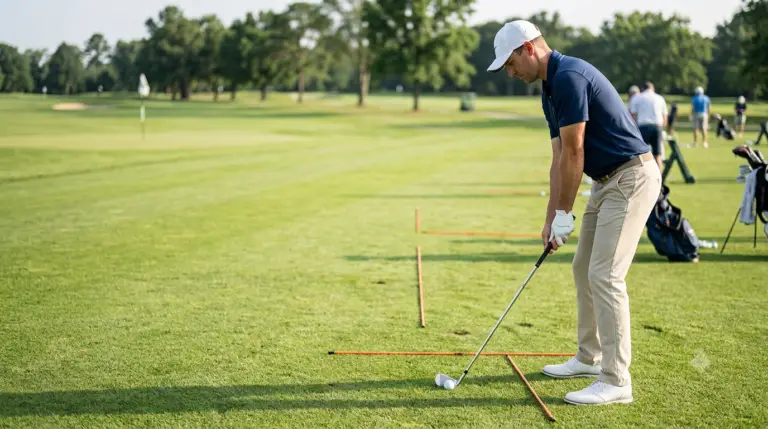
The Alignment Stick Drill
Place an alignment stick on the ground to create a visual target line.
Use it to check:
- Clubface direction.
- Foot alignment.
- Shoulder alignment.
- Starting direction.
This drill is particularly useful because golfers often perceive their alignment differently from how they are actually positioned.
The Pump Drill
The pump drill helps you rehearse the transition.
- Make your normal backswing.
- Slowly move the club into the beginning of the downswing.
- Return to the top.
- Repeat the movement two or three times.
- Then make a controlled swing.
Don’t worry about producing maximum speed. Concentrate on repeating the same transition.
The Half-Swing Drill
If your full swing produces a severe slice, temporarily make it smaller.
Hit half shots while focusing on contact and starting direction.
Your goal is to learn what a controlled strike feels like. Once your ball flight becomes more predictable, gradually increase your swing length.
How to Fix a Slice With a Driver
The driver often makes a slice look worse.
That’s partly because the driver is longer and is normally swung faster than your irons. Small delivery differences can therefore have a bigger effect on the final ball flight.
Check Your Driver Setup
Start with:
- Ball position.
- Tee height.
- Distance from the ball.
- Shoulder tilt.
- Clubface alignment.
- Posture.
Don’t make five changes at once. Pick one variable, hit several shots, and observe what happens.
Focus on Smooth Tempo
You don’t need to attack the driver as hard as possible.
If your tempo becomes rushed, your transition may become less controlled. That can make it harder to deliver the club consistently.
Try making a few swings at approximately 70–80% effort. If your contact and direction improve, you have valuable information about what happens when you reduce unnecessary tension.
Practice Starting the Ball on a Specific Line
Pick a target and imagine a starting window.
Instead of simply asking, “Did I slice it?”, ask:
Where did the ball start, and how much did it curve?
That gives you more useful feedback.
A ball that starts slightly right and curves farther right tells you something different from a ball that starts left and curves back toward the target.
Common Mistakes Golfers Make When Trying to Fix a Slice
Aiming Farther Left
This is one of the easiest compensations.
You may find more fairways temporarily, but your swing mechanics haven’t necessarily improved.
Use alignment changes to correct your setup, not to permanently accommodate a severe slice.
Trying to Swing Harder
More speed isn’t automatically better.
When you swing aggressively, you may lose control of your transition and club path.
Build consistency first. Speed can come later.
Trying to Close the Clubface Too Much
If your slice comes from an open clubface, you might be tempted to close it dramatically.
That can lead to pulls, hooks, and unpredictable contact.
Make smaller adjustments and observe the result.
Changing Too Many Things at Once
This is perhaps the most important practice rule.
If you change your grip, stance, ball position, backswing, downswing, and release simultaneously, you won’t know which change actually helped.
Instead:
- Identify one likely problem.
- Make one adjustment.
- Hit several shots.
- Observe the pattern.
- Keep or discard the change.
- Move to the next variable.
A Simple 15-Minute Golf Slice Practice Routine
You can turn the ideas above into a short range session.
| Time | Practice | Main Goal |
|---|---|---|
| 3 minutes | Setup and alignment | Build consistency |
| 3 minutes | Half swings | Improve contact |
| 3 minutes | Headcover/path drill | Improve swing path |
| 3 minutes | Driver practice | Transfer the feeling |
| 3 minutes | Target practice | Test your ball flight |
During the session, don’t judge yourself based on one shot.
Look for patterns.
Ask yourself:
- Where did the ball start?
- Which direction did it curve?
- Was contact solid?
- Did the same pattern appear repeatedly?
That information is far more useful than simply labeling every bad shot a “slice.”
How Long Does It Take to Fix a Golf Slice?
There isn’t a universal timeline.
You might notice an improvement after one simple setup change. However, turning that improvement into a reliable ball flight requires repetition.
Your practice should focus on quality rather than hitting hundreds of balls without a clear purpose.
If you have been slicing for years, don’t expect one range session to completely transform your swing.
If your slice remains severe despite consistent practice, consider working with a qualified golf professional. A coach can observe your swing directly and, when available, use launch-monitor data to examine factors such as club path, face angle, face-to-path relationship, club speed, and attack angle.
That information can help you stop guessing.
Golf Slice Fixes: Quick Checklist
Before your next range session, work through this list:
- Check your grip.
- Square the clubface at address.
- Check your feet, hips, and shoulders.
- Confirm your ball position.
- Avoid an exaggerated outside-to-in path.
- Practice half swings.
- Use a headcover or alignment-stick drill.
- Focus on solid contact.
- Reduce unnecessary tension.
- Avoid swinging harder to fix the problem.
- Change only one variable at a time.
- Track the starting direction and curvature.
- Get professional feedback if you’re stuck.
Frequently Asked Questions About How to Fix a Slice in Golf
How to Fix a Slice in Golf Quickly?
Start with the fundamentals rather than rebuilding your entire swing. Check your grip, alignment, clubface position, and swing path. For many golfers, improving setup and reducing an exaggerated outside-to-in movement can make the ball flight more manageable.
What Is the Main Cause of a Golf Slice?
A slice can have several causes, but clubface orientation relative to swing path is a major factor. An open clubface combined with an outside-to-in path can produce significant left-to-right curvature for a right-handed golfer.
Does a Weak Grip Cause a Golf Slice?
A weak grip can contribute to difficulty controlling the clubface for some golfers. However, it is not automatically the cause of every slice. Look at your grip together with your clubface position, swing path, and impact pattern.
Can Changing My Swing Path Fix a Slice?
It can help significantly if your swing path is excessively outside-to-in. However, don’t focus exclusively on path. Your clubface relationship to that path also matters.
Why Does My Driver Slice More Than My Irons?
Your driver is longer and typically swung faster. You also use a different setup and ball position. These differences can make an existing swing-path or clubface issue more obvious with the driver.
Should You Aim Left to Fix a Slice?
Not necessarily. Aiming left can compensate for your normal ball flight, but it doesn’t correct the cause. If you want a more reliable game, focus on improving your clubface control, swing path, and setup.
How to Fix a Slice in Golf Without Changing Your Swing?
You can start with setup changes such as checking your grip, alignment, ball position, tee height, and tempo. These adjustments may improve your ball flight, although a persistent slice may require a technical swing change.
Conclusion: Take Control of Your Ball Flight
Learning how to fix a slice in golf starts with understanding why the ball is curving in the first place.
Instead of automatically aiming farther left or swinging harder, take a more methodical approach. Check your grip and alignment. Pay attention to your clubface. Work on reducing an exaggerated outside-to-in path. Then use simple drills to turn those changes into a repeatable motion.
Most importantly, don’t try to fix everything in one practice session.
Pick one adjustment, hit a series of shots, and pay attention to the pattern. Your goal isn’t to hit one perfect ball. Your goal is to make your good shots more predictable.
A golf slice doesn’t have to define your game. With focused practice, better feedback, and a little patience, you can start producing straighter, more controlled ball flights and approach your next tee shot with much more confidence.
Ready to work on your slice? Take these drills to the range this week, record your ball flight, and focus on one change at a time. Once you start understanding what your clubface and swing path are doing, fixing your slice becomes much less frustrating—and much more achievable.
Post Reviews
There are no reviews yet. Be the first one to write one.