Golf Grips for Slice: What Is a Slice in Golf?

You hit what feels like a perfect drive. The contact sounds clean, the ball launches toward the fairway, and for a moment you think you have finally found your swing. Then it happens: the ball starts drifting to the right and keeps moving farther and farther away from your target.
If you regularly experience this, you know how frustrating a golf slice can be. You start aiming farther left, changing your swing, gripping the club tighter, and sometimes even blaming your driver. Before long, you are playing golf defensively instead of confidently.
The good news is that you can fix a slice. The first step is understanding why it happens.
Your grip, clubface, swing path, alignment, ball position, and equipment can all influence your ball flight. Once you identify what is actually causing your slice, you can work on the right correction instead of simply trying to hit the ball harder or aiming farther left.
In this guide, you will learn what a slice is, what causes it, how it affects your game, how golf grips for slice can help, and which drills you can use to start hitting straighter shots.
Table of Contents
What Is a Slice in Golf?
A slice is a golf shot that curves significantly away from your intended target after impact. For a right-handed golfer, a traditional slice curves strongly to the right. For a left-handed golfer, the curve goes in the opposite direction.
A slice is different from a controlled fade. A fade has a relatively small, predictable curve, while a slice usually has excessive curvature that makes it difficult to control your distance and direction.
The important thing to understand is that the ball does not curve simply because you “swung badly.” The relationship between your clubface and club path at impact plays a major role.
According to TrackMan, face-to-path is the difference between the direction your clubface is pointing and the direction the clubhead is traveling. This relationship is a key factor in determining the curvature of your shot.
Golf Slice vs. Fade
| Shot | Typical Ball Flight | Control |
|---|---|---|
| Straight shot | Travels mostly toward the target | High |
| Fade | Slight curve to the right for right-handed golfers | Usually predictable |
| Slice | Strong curve to the right for right-handed golfers | Difficult to control |
| Hook | Strong curve to the left for right-handed golfers | Difficult to control |
If you see a small amount of right-to-left or left-to-right movement that you can predict, you may not have a serious problem. When the ball curves dramatically and repeatedly, however, you are dealing with a slice that deserves attention.
What Causes a Golf Slice?
A slice can have several causes, but two of the biggest factors are an open clubface and an excessive outside-to-in swing path.
PGA instruction resources commonly identify an open clubface and an over-the-top or outside-to-in movement as major contributors to slicing.
An Open Clubface at Impact
Your clubface has a huge influence on where the ball starts and how it curves.
If your clubface is open relative to your swing path, you create conditions for the ball to curve to the right as a right-handed golfer.
Your grip can contribute to this problem. If your lead hand is positioned too weakly and your hands struggle to rotate naturally through impact, the clubface may remain open.
That does not mean you should automatically turn your hands into an extremely strong grip. Your goal is a functional, repeatable grip that gives you control of the clubface.
An Outside-to-In Swing Path
Another common problem is an outside-to-in swing path.
Imagine your target line running directly toward the fairway. Instead of approaching the ball from a neutral or slightly inside path, your club travels from outside that line toward the inside during the downswing.
This is often called an “over-the-top” move.
TrackMan defines club path according to the direction the clubhead is moving at impact, including whether it is moving in-to-out or out-to-in.
When you combine an outside-to-in path with a clubface that is open relative to that path, you create a recipe for a slice.
A Poor Golf Grip
Your grip is your only physical connection to the golf club, so it deserves serious attention.
A poor grip can make clubface control more difficult. PGA instruction specifically emphasizes the connection between hand placement, wrist action, and clubface position.
Look at these common grip problems:
- Your lead hand is positioned too weakly.
- Your trail hand sits incorrectly underneath or on top of the grip.
- You squeeze the club excessively.
- Your hand position changes during the swing.
- Your grip is too small or too large for your hands and preferences.
Before changing your entire swing, check whether your grip is giving you a stable starting point.
Incorrect Alignment
Your setup can also encourage a slice.
If you repeatedly aim too far left because you are afraid of missing right, you may unintentionally encourage an outside-to-in swing path.
This creates a frustrating cycle:
- You slice right.
- You aim farther left.
- Your swing moves more across the ball.
- The slice becomes worse.
- You aim even farther left.
PGA coaching advice specifically warns against simply aiming farther left to compensate for a slice because it can reinforce the cutting swing that causes the problem.
Incorrect Ball Position
Ball position matters because the clubface and swing path are changing throughout your swing.
If your ball is too far forward or too far back, you can change the point at which the club contacts the ball. PGA instruction notes that ball position can influence the clubface’s orientation at impact.
Your goal is not to make a dramatic change. Start by checking that your ball position is appropriate for the club you are using and remains consistent.
How a Golf Slice Affects Your Game
A slice is more than an annoying curve. It can have a direct impact on your scores.
You Lose Distance
A severe slice often produces an inefficient ball flight.
Instead of traveling toward your target, the ball spends part of its flight moving sideways. Excessive face-to-path differences can also be associated with less efficient shots and distance loss.
That means a drive that should leave you with a short approach may instead leave you in the rough or behind a hazard.
You Miss Fairways
When your ball consistently curves right, you have fewer usable landing areas.
You may find yourself hitting from:
- Deep rough
- Fairway bunkers
- Trees
- Penalty areas
- Out-of-bounds areas
And even when the ball stays in play, you may have a difficult angle into the green.
Your Confidence Drops
This may be the biggest problem of all.
Once you expect your driver to slice, you start thinking about the miss before you even swing.
You may think:
“Don’t go right.”
Then you aim left, manipulate your swing, tighten your grip, and try to steer the club toward the fairway.
Golf becomes much easier when you trust your starting line. Fixing your slice can therefore improve more than your ball flight—it can improve your confidence.
Golf Grips for Slice: Can the Right Grip Help?
If you are searching for golf grips for slice, it is important to understand what changing your grip can and cannot do.
A new grip will not magically correct an outside-to-in swing path. However, the right grip can give you better comfort, consistency, and control.
Your hands determine how you interact with the clubface throughout the swing. PGA instruction emphasizes that grip position has an important relationship with clubface control.
What Should You Look for in Golf Grips for Slice?
When choosing grips, pay attention to:
- Grip size
- Texture
- Traction
- Firmness
- Comfort
- Hand size
- Your typical grip pressure
The most important point is consistency.
If your grip is uncomfortable, you may compensate by squeezing harder. If it is too large or too small for you, the way your hands interact with the club can change.
Standard, Midsize, or Oversize?
There is no universal grip size that fixes every slice.
| Grip Size | Potential Advantage | Consideration |
|---|---|---|
| Standard | Familiar feel for many golfers | May not suit every hand |
| Midsize | More material under the hands | Can change wrist feel |
| Oversize | Stable, substantial feel | May influence how freely your hands move |
Instead of buying a particular grip simply because it is advertised as “slice correcting,” consider getting your grip size evaluated.
The best golf grips for slice are ultimately the ones that help you maintain a comfortable, repeatable grip and appropriate pressure.
Can a Stronger Grip Fix a Slice?
Sometimes, yes—but not automatically.
A stronger grip can make it easier for some golfers to return the clubface to a more closed position. PGA instruction notes that golfers struggling with an open clubface and limited wrist action may benefit from experimenting with a stronger grip.
However, going too strong can create a new problem: a hook.
Your goal should be a functional grip, not simply the strongest grip possible.
How to Fix a Golf Slice Step by Step
Instead of changing everything at once, work through your swing systematically.
Step 1: Check Your Grip
Start with your hands.
Make sure:
- Your hands are positioned consistently.
- The grip sits correctly in your lead hand.
- Your trail hand connects naturally.
- You are not squeezing the club excessively.
- You can maintain the same grip throughout your swing.
Practice your grip without hitting balls first. Build consistency before adding speed.
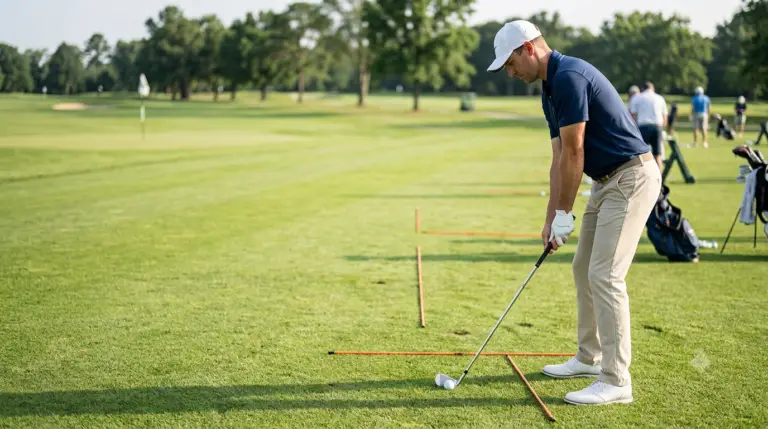
Step 2: Check Your Alignment
Place a club or alignment stick on the ground and create a clear target line.
Then check:
- Clubface
- Feet
- Hips
- Shoulders
Your body does not necessarily need to point directly at the target. The important thing is that your setup is consistent and appropriate for your intended shot.
Step 3: Improve Your Swing Path
Your goal is not necessarily to create an extreme inside-to-out swing.
Instead, work toward a more neutral path.
Try to avoid aggressively throwing the club over the top from the beginning of your downswing.
A useful feeling for some golfers is allowing the trail elbow to work closer to the trail side instead of immediately moving outward. PGA coaching has specifically recommended this concept when working on an outside-to-in path. (pga.com)
Step 4: Learn to Control the Clubface
You need to know what your clubface is doing.
Practice short shots while paying attention to:
- Starting direction
- Curvature
- Contact
- Finish position
Do not immediately worry about hitting the ball as far as possible.
A controlled 50-yard shot that starts on the intended line teaches you more than a 250-yard slice.
Step 5: Start With Shorter Clubs
Begin your practice with wedges and short irons.
Then gradually move toward:
- Mid-irons
- Long irons or hybrids
- Fairway woods
- Driver
This gives you an opportunity to build a better movement before adding the extra speed and length of the driver.
Drills to Help Fix Your Golf Slice
The Headcover Drill
Place a headcover outside the ball, slightly behind it.
The goal is to avoid hitting the headcover while making your normal swing.
This can give you a useful external reference for avoiding an exaggerated outside-to-in movement. PGA coaches use variations of this concept as a slice drill.
Start slowly and focus on making controlled contact.
The Alignment Stick Drill
An alignment stick can help you visualize your target line and club path.
Use it to create a practice station where you can rehearse a more desirable approach into the ball.
PGA Coach instruction has recommended alignment-stick drills as a way to develop better path awareness when working on a slice.
The Half-Swing Drill
Take your driver out of your hands for a moment.
Use a short iron and make controlled half-swings.
Focus on:
- Solid contact
- Starting direction
- Balanced finish
- Consistent grip pressure
Once you can control the half-swing, gradually increase the length of your motion.
The Grip-Pressure Drill
Try hitting short shots with a lighter, consistent grip pressure.
You should feel that the club is secure without feeling like you are trying to crush the handle.
This can help you become more aware of unnecessary tension.
Common Mistakes When Trying to Fix a Slice
Aiming Farther Left
This is probably the most common compensation.
It may keep some balls in play, but it does not necessarily address the cause of the slice. In fact, it can encourage the very swing path you are trying to eliminate.
Swinging Harder
If you already have an outside-to-in path, adding speed can make your miss even bigger.
Work on control first. Add speed later.
Changing Everything at Once
Do not change your grip, stance, backswing, ball position, equipment, and downswing simultaneously.
You will have no idea which change helped.
Instead, make one adjustment, hit several shots, and observe the result.
Blaming Your Driver
Your equipment matters, but your driver is not automatically responsible for your slice.
Properly fitted equipment can help, and PGA professionals recommend fitting as part of evaluating equipment suitability.
However, you should still determine whether the main issue is your swing mechanics.
Golf Slice vs. Other Common Ball Flights
| Ball Flight | Starting Direction | Curvature | Possible Clue |
|---|---|---|---|
| Push | Right | Little | Face/path relationship may be relatively square |
| Push-slice | Right | Further right | Face and path relationship produces curvature |
| Slice | Straight/left/right | Strong right for right-handed golfer | Often open face relative to path |
| Fade | Straight/left | Slight right | Controlled face-to-path difference |
| Hook | Straight/right | Strong left | Face relatively closed to path |
Remember that ball flight alone cannot diagnose your swing perfectly. Launch-monitor information can give you a clearer picture.
How to Know If Your Slice Is Improving
Don’t judge improvement only by whether the ball looks straighter.
Track your results.
Pay attention to:
- Starting direction
- Curvature
- Carry distance
- Total distance
- Strike location
- Clubface angle
- Club path
- Face-to-path
- Dispersion
If you have access to a launch monitor, these measurements can be extremely useful.
TrackMan defines club path, face angle, and face-to-path as separate club-delivery measurements that help explain ball flight.
For example, if your ball starts closer to the target and curves less, you may be making progress even if you are not yet hitting perfect straight shots.
You do not need to eliminate every degree of curvature. Your goal is to develop a predictable, playable ball flight.
When Should You Get Professional Golf Instruction?
If you have been fighting the same slice for months, a golf lesson may save you a lot of frustration.
A PGA professional can observe your swing in real time and determine whether your primary issue comes from:
- Grip
- Setup
- Ball position
- Takeaway
- Backswing
- Transition
- Club path
- Clubface
- Impact
- Equipment
This is particularly valuable if you have already tried several online drills but keep returning to the same ball flight.
Instead of guessing, you can work from actual feedback.
Frequently Asked Questions About Golf Grips for Slice
Can golf grips for slice actually fix a slice?
The right grip can help you establish more consistent hand placement and clubface control, but it is not a guaranteed cure. If your slice is caused primarily by an outside-to-in path, you will need to work on your swing as well.
What are the best golf grips for slice?
There is no single best grip for every golfer who slices. Look for a size, texture, and firmness that allow you to hold the club comfortably and consistently. A professional grip fitting can help you determine what suits your hands and swing.
Does a stronger grip fix a golf slice?
A stronger grip can help some golfers who struggle with an open clubface, but it is not a universal solution. If you make the grip excessively strong, you may simply replace your slice with a hook.
Why do you slice your driver but not your irons?
Your driver is longer and is typically swung faster, which can expose swing-path and clubface-control issues that are less obvious with shorter clubs. Your setup and ball position are also different.
Does grip size affect a golf slice?
It can influence how your hands interact with the club and how comfortable it feels during the swing. However, you should not assume that a larger or smaller grip automatically eliminates a slice.
Why does your golf ball start straight and then curve right?
For a right-handed golfer, this can occur when the clubface is relatively open to the swing path. TrackMan’s face-to-path model shows that the difference between face angle and club path is a key factor in curvature. (Trackman)
Can changing your grip pressure reduce a golf slice?
It may help if excessive tension is interfering with your ability to make a consistent swing. Rather than squeezing harder, aim for secure and repeatable pressure.
Conclusion: Stop Fighting Your Slice and Start Understanding It
A golf slice can make the game feel harder than it needs to be. You lose distance, miss fairways, face difficult approach shots, and eventually start playing around your miss instead of trusting your swing.
But you can change it.
Start by understanding the relationship between your clubface and swing path. Then check your grip, alignment, ball position, and setup. If you are researching golf grips for slice, remember that the right grip can support better consistency and control, but it should be part of a broader solution rather than treated as a magic fix.
Most importantly, do not try to repair your entire swing in one afternoon.
Start with your grip. Check your alignment. Work on your path. Practice with shorter clubs. Use simple drills and track your ball flight.
If you have access to a launch monitor or PGA professional, use that feedback to identify what is actually happening at impact rather than guessing.
Your slice does not have to define your golf game.
Ready to hit straighter shots? Start your next practice session by checking your grip and alignment, then spend 15–20 minutes working on one slice-fixing drill before moving back to the course.
Post Reviews
There are no reviews yet. Be the first one to write one.